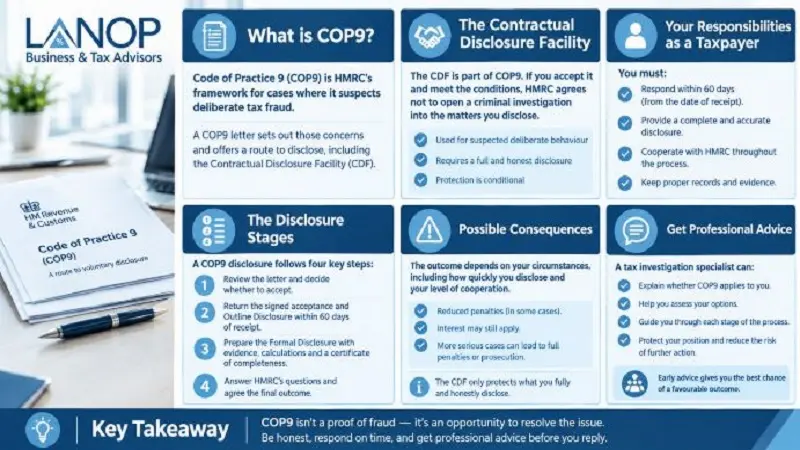
An HMRC letter that mentions Code of Practice 9 (COP9) rattles almost everyone who opens it. Your first call may well be to a tax investigation specialist, and that instinct is sound. HMRC uses COP9 when it suspects tax fraud, and the letter comes with an offer called the Contractual Disclosure Facility (CDF). It lets you disclose deliberate irregularities on set conditions. You normally have 60 days to respond. Here is what to do first, how disclosure works, what HMRC expects to see, and what happens when your records have gaps.
What is COP9, and does it mean HMRC has proved fraud?
No. The letter signals suspicion, not a finding. HMRC sends it when the information it holds points to deliberate behaviour, and it offers the CDF instead of heading straight into a criminal investigation.
The CDF works as a contract. If you accept it and comply, HMRC agrees not to criminally investigate the irregularities you disclose in your Outline Disclosure. That protection is conditional, and false or incomplete disclosures can end it.
COP9 doesn’t cover every mistake, either. An honest error, careless behaviour and deliberate behaviour are different things, and the CDF is meant for the last one. Pick the wrong route, and you could admit to something you didn’t do or miss the protection you needed.
What should you do after receiving a COP9 letter?
Read it twice, then find the date. You have 60 days from receipt to accept or reject the offer. HMRC’s guidance expects the signed acceptance and a valid Outline Disclosure back inside that same window. That’s not the time allowed for the whole investigation. It’s the opening move.
Treat the decision seriously. Accepting commits you to full disclosure. Rejecting leaves HMRC free to investigate on its own terms. Before you choose, you need to understand what HMRC suspects, what records you hold and what the CDF demands. Take independent advice first. HMRC’s own guidance says you can appoint an adviser who specialises in COP9.
Struggling with the deadline? Call an adviser early. Don’t assume HMRC will grant an extension, because it won’t do so automatically.
How does a voluntary disclosure under COP9 work?
It runs in four stages:
- Review the offer.Note the deadline, gather returns, accounts and bank records, and work out which taxes, periods and transactions are involved.
- Make the Outline Disclosure.Give an honest account of the deliberate behaviour and the tax lost. HMRC doesn’t expect every final figure yet, but the disclosure must be valid.
- Prepare the Formal Disclosure.This is the full report, with evidence, calculations of the tax lost and a certificate confirming the disclosure is complete. Expect detailed work across several years.
- Answer HMRC’s questions.HMRC reviews the information and tests it against your records. Then the tax, interest and penalties get settled. The timescale depends on the case.
What do you have to disclose?
Everything relevant, not just the problem you think HMRC already knows about. Leave out another deliberate irregularity, and HMRC may treat your outline as incomplete and put the CDF terms in doubt.
How far back does it go? That depends on the tax, the behaviour and the legal time limits. Deliberate behaviour can reach back up to 20 years, but not every case does. Overseas income, accounts and assets count too. Don’t assume they sit outside the process.
What if your records are missing?
Gaps don’t cancel your duty to disclose honestly. Say you ran a café and the 2019 till rolls are gone. That’s a hypothetical example, but a common one. Your adviser can rebuild the picture from bank statements, supplier invoices and card payments, and label every estimate as an estimate. Explain the gaps. Never invent figures.
Start gathering:
- Tax returns and calculations
- Business accounts and bookkeeping records
- Bank statements
- Sales and purchase invoices
- Payroll and VAT records
- Overseas account statements
- Relevant emails, spreadsheets and accounting software files
If you spot another error midway, tell your adviser straight away. And never change, destroy or backdate an original record.
What happens if your disclosure is incomplete?
The CDF depends on a complete, accurate and honest disclosure. Material omissions, false statements or a refusal to cooperate can cost you its protection.
Not knowing the exact amount yet is different from hiding something. If figures are uncertain, say what you know, what you don’t and how you’re working it out. Never guess, and never submit numbers you believe are wrong.
How does COP9 differ from other disclosure routes?
| Route | When it may apply |
| COP9 and the CDF | HMRC suspects deliberate fraud. Protection is conditional. |
| COP8 | A different procedure with a different purpose. Check HMRC’s guidance for your case. |
| Digital Disclosure Service | Certain tax irregularities. It isn’t a general fix for every error. |
| Waiting for HMRC | Delay tends to make problems harder to resolve. It promises no protection from penalties or prosecution. |
Will you pay tax, interest and penalties?
Expect to deal with up to three separate things. Tax is the amount owed. Interest is a charge on the unpaid amount. Penalties depend on your behaviour and the rules that apply, and an honest mistake doesn’t automatically bring one.
Accepting COP9 isn’t blanket immunity. The CDF protects what you disclose, not unrelated offences. If you can’t afford the bill, tell HMRC. It may agree to a payment arrangement, though that’s HMRC’s decision.
How do you choose a tax investigation specialist?
Look for COP9 and CDF experience specifically. Ask:
- Who will handle my case and speak to HMRC?
- What does the fee cover?
- How will you deal with missing records and uncertain figures?
- How will you keep me updated on risks and liabilities?
Your usual accountant knows your records, but that doesn’t prove COP9 experience. Ask directly. Fees depend on the complexity, the number of years involved and the quality of your records, so insist on a written scope of work.
Frequently asked questions
What happens if I receive a COP9 letter?
Take it seriously and note the 60-day deadline. Get specialist advice before you reply.
What happens if I miss the 60 days?
Contact an adviser immediately. HMRC’s response depends on your circumstances, and delay narrows your options.
Can I use COP9 to correct an honest mistake?
No, because the CDF is for deliberate behaviour. Other disclosure routes may suit honest errors better.
Can HMRC investigate tax affairs going back 20 years?
Only in some cases, depending on the tax and your behaviour. Deliberate behaviour can extend the time limit up to 20 years.
Can I be prosecuted after making a disclosure?
The CDF protection is conditional. It covers what you fully and honestly disclose, and false or incomplete disclosure can end it.
Conclusion
Understand the offer, check the deadline, choose the correct route and disclose completely. Be honest about gaps in your records, because honesty is what the CDF rests on. Its protection is conditional, so get advice before you reply.
Not sure where you stand? Talk it through with a tax investigation specialist before you respond. Lanop Business & Tax Advisors can explain your options and what HMRC’s letter means for you, and you can read more on our HMRC tax investigations service page. See more